Dozens Killed in Russian Strike on Aid Center
Russian Bombs Strike Ukrainian School Shelter, Killing at Least 31 as Rescuers Search for Missing Civilians
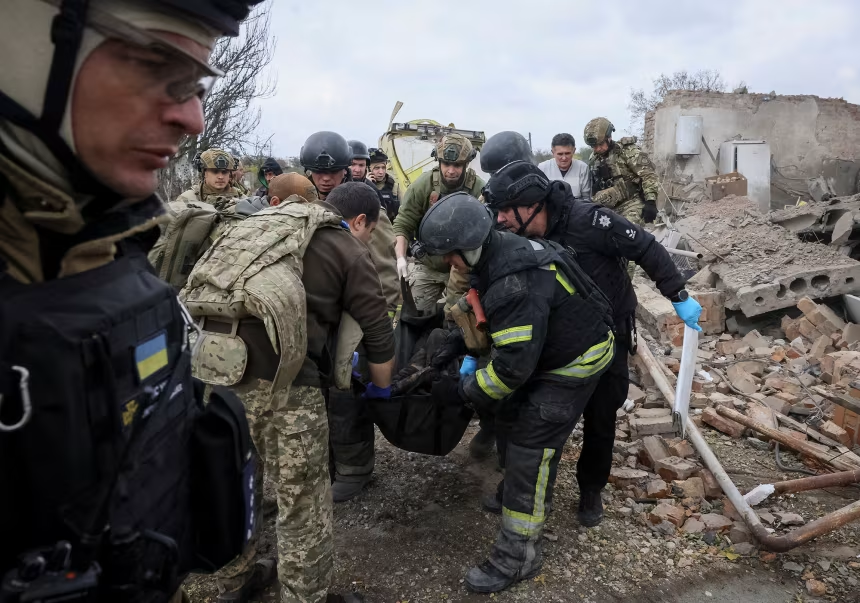
Ukrainian officials say Russian forces launched repeated airstrikes against a school building used for humanitarian aid in the Zaporizhzhia region, collapsing a reinforced underground shelter and killing civilians, police officers, and emergency responders.
At least 31 people were killed after Russian aerial bombs struck a school building being used as a humanitarian aid center and shelter in southeastern Ukraine, according to Ukrainian regional authorities. Dozens more were reported missing as emergency crews searched through the wreckage.
The attack took place on November 2 in Komyshuvakha, a community near the front line in Ukraine's Zaporizhzhia region. Ukrainian President Volodymyr Zelensky said Russian forces first bombed the school building before launching a second wave involving nine additional aerial bombs against the shelter where people had taken cover.
The building was no longer operating as a regular school. Instead, local authorities were using it to distribute humanitarian assistance and provide protection for residents who remained in the area despite the continuing war.
The strikes caused extensive destruction, including the collapse of a reinforced underground shelter that had been built to protect people from wartime attacks.
A Second Wave of Bombs Struck the Shelter
According to Zelensky, the initial Russian airstrike hit the school while residents were gathering to receive humanitarian supplies.
After the first explosions, civilians and emergency personnel sought protection underground.
Ukrainian officials said a subsequent wave of nine bombs struck the shelter, trapping people beneath collapsed concrete and debris.
The sequence is particularly significant because emergency crews had already begun responding to the initial attack.
Ukraine's emergency services confirmed that two rescue workers were among those killed. Ukrainian police also reported the deaths of four officers who had been assisting residents at the scene.
The reported pattern resembles what military analysts describe as a double-tap strike, in which an initial attack is followed by another strike on the same location. Such attacks can expose rescuers and people seeking shelter to additional danger.
Ukrainian authorities accused Russian forces of deliberately targeting the location during humanitarian operations. The reported circumstances of the second strike have not been independently established in full.
A Reinforced Shelter Could Not Withstand the Bombing
One of the most consequential details involved the shelter itself.
Local officials said the underground facility had been constructed with European Union funding and reinforced to withstand substantial wartime damage.
Originally intended to help children continue their education during the war, the shelter later became part of a humanitarian support center as fighting intensified and many families evacuated the community.
Those who remained depended on the location for assistance.
Regional official Mykhailo Semikin said the Russian attack involved powerful aerial bombs, including KAB-500 and FAB-3000 weapons.
The FAB-3000 is a large aerial bomb weighing approximately three metric tons, with an explosive payload capable of causing extensive damage to reinforced structures.
According to Semikin, the force of the explosions overwhelmed the shelter's concrete construction, causing it to collapse. A fire also broke out following the strikes.
For civilians inside, the collapse turned a place designed for protection into a scene of widespread destruction.
Rescue Workers and Police Among the Dead
The casualty figures increased as Ukrainian emergency crews continued searching the damaged site.
Regional authorities reported at least 31 confirmed deaths on November 3, although earlier accounts had placed the toll at 24 or 26.
Semikin also reported that as many as 48 people remained unaccounted for. Other Ukrainian officials gave lower missing-person figures, indicating that the full number of people affected had not yet been reconciled.
The number of missing people should not be treated as a confirmed additional death toll.
Two emergency responders, Denys Konovalenko and Oleksiy Sushchevsky, both 44, were identified among those killed.
Ukrainian police also named four officers who died while responding to the attack.
Rescue teams faced difficult conditions as they searched through shattered concrete and damaged buildings. Ukrainian officials reported that additional Russian drone activity complicated the emergency response.
The continuing search raised concerns that the death toll could increase as workers reached areas buried beneath the rubble.
Russia and Ukraine Offer Conflicting Accounts
President Zelensky condemned the bombing and said the attack demonstrated Moscow's unwillingness to pursue de-escalation.
He emphasized that the school was being used for humanitarian purposes and that residents regularly gathered there to receive essential supplies.
Russia's Defense Ministry, meanwhile, said its forces had targeted Ukrainian military units in the area and claimed that Ukrainian service members had been killed.
That Russian account differs from the Ukrainian description of a humanitarian aid center and civilian shelter.
The military claims and the precise circumstances surrounding the strikes have not been independently verified in full.
Under international humanitarian law, parties to an armed conflict must distinguish between civilian objects and military objectives. Attacks must also comply with rules governing proportionality and precautions to protect civilians.
Determining whether a particular strike violated those rules requires a detailed examination of the target, available military information, the weapons employed, and the circumstances of the attack.
The Bombing Comes Amid Fragile Diplomatic Efforts
The attack occurred shortly after a limited humanitarian ceasefire in southern Ukraine had expired.
That temporary arrangement had supported aid deliveries and civilian evacuations connected to Oleshky, a Russian-occupied city in the neighboring Kherson region.
The ceasefire was geographically limited and did not establish a nationwide suspension of fighting.
Nevertheless, the timing of the Komyshuvakha bombing added to concerns about the prospects for broader de-escalation.
Zelensky argued that the strikes undermined hopes that recent humanitarian cooperation might lead to further progress.
The attack also came as Washington continued diplomatic efforts involving Russia and Ukraine.
U.S.-mediated discussions were expected in Abu Dhabi on November 10 and 11, with security arrangements, de-escalation, and humanitarian issues among the planned subjects.
The bombing did not establish whether those negotiations would be canceled or changed, but it highlighted the difficulties facing efforts to reduce violence while major combat operations continued.
What Happens Next?
Ukrainian emergency authorities continued efforts to locate missing people and account for those believed to have been inside the shelter.
The immediate priorities included searching unstable wreckage, treating survivors, identifying victims, and determining the full extent of the destruction.
Important questions remained unanswered, including the final casualty toll, the circumstances of the second wave of bombing, and whether investigators would be able to establish the intended targets.
For the remaining residents of Komyshuvakha, the destruction also meant the loss of a facility that had provided both humanitarian assistance and physical protection near the front line.
The attack demonstrated the limits of reinforced civilian shelters when exposed to exceptionally powerful aerial weapons.
As rescue operations continued, the central unresolved issue was how many people were still trapped or missing beneath the wreckage of a building where residents had gathered for safety and humanitarian aid.
Comments (0)
Loading comments...
May You Like

Why Is Trump Ending Israel Aid Now?

Congress Could Change Hands After Election Day
Who Controls the Senate at 50-50?



Popular Posts
Why Is Trump Ending Israel Aid Now?
Nov 3, 2026